
An estimated 87% of Protestant pastors now use AI in ministry — only 13% don't — according to Barna Group / Gloo, 2026 (fielded late 2025). A separate Exponential survey found 91% of church leaders support AI use in some form. Adoption has climbed fast: from roughly 38% of church leaders in 2023 to 66% in 2024.
"Study to shew thyself approved unto God, a workman that needeth not to be ashamed, rightly dividing the word of truth." — 2 Timothy 2:15
How many pastors use AI?
AI has gone from a novelty to a normal part of ministry in about three years. When Barna Group and Gloo asked Protestant pastors directly, the headline number surprised even close observers of the church: the overwhelming majority are already using it.
87% of pastors use AI in ministry. Only 13% say they don't.
That figure comes from Barna/Gloo's 2026 research (fielded late 2025). It isn't an outlier, either. A separate nationwide survey run through AiForChurchLeaders and shared by Exponential put the picture like this:
- 87%of Protestant pastors use AI in ministry — only 13% do not (Barna/Gloo, 2026, fielded late 2025).
- 91%of church leaders support AI use to some degree (AiForChurchLeaders / Exponential survey).
- 61%of church leaders use AI weekly or daily — up from 43% in 2024 (Exponential).
- 64%of preaching pastors use AI in sermon preparation (Exponential).
- 38→66%church-leader AI use nearly doubled from about 38% in 2023 to 66% in 2024 (Gloo).
Put plainly: the question is no longer whether pastors use AI, but how — and how carefully. For the wider picture of how the church at large is adopting these tools, see our Christian AI adoption statistics, part of the pillar guide on AI and Christianity.
What pastors use AI for
Pastors aren't outsourcing the pulpit. The Barna/Gloo data shows AI clustering around the preparation and operations side of ministry — the research, drafting, and admin that happen before anyone stands up to preach. Here's the breakdown of the most common pastoral uses:
| How pastors use AI | Share |
|---|---|
| Brainstorming ideas | 50% |
| Graphic design | 37% |
| Biblical & theological research | 36% |
| Writing small-group questions | 34% |
| Administrative work | 34% |
| Writing or editing sermons | 24%2× the 12% in early 2024 |
The most-watched number is sermons: 24% of pastors now use AI to write or edit sermons — double the 12% recorded in early 2024. That's the fastest-moving line in the dataset, and the one that raises the most questions about accuracy and authenticity. We unpack the theology and the practical guardrails in should pastors use AI for sermons?
"They're using it to prepare for ministry, not to replace what happens when they're actually with people."
— Daniel Copeland, Vice President of Research, Barna GroupCopeland's framing matters. The data doesn't show pastors handing spiritual formation to a machine; it shows them reaching for a research and drafting assistant. The line most of them are drawing is between the desk and the room — the study versus the hospital bedside, the outline versus the actual encounter. If you want a walkthrough of doing this well, our sermon prep use case shows a Scripture-first workflow step by step.
The trust gap
Here's the tension at the heart of the data: the same pastors adopting AI at record speed do not, on the whole, trust it. Use is soaring while confidence lags — and nowhere is that gap wider than with Scripture. Barna/Gloo's numbers capture it:
- 72%of pastors call AI a "threat" to the church (Barna/Gloo).
- 79%of pastors say AI is biased (Barna/Gloo).
- 12%of pastors feel prepared to give guidance on how their congregation should use AI (Barna/Gloo).
Read those three lines together and the shape of the problem appears. Most pastors are using a tool they consider both biased and threatening, while only about one in eight feels equipped to counsel anyone else on it. That's not hypocrisy — it's a genuine leadership gap. The tools arrived faster than the wisdom to steward them.
The distrust is well-founded when it comes to the text itself. General-purpose AI is a category built to predict likely wording, not to reproduce a fixed verse — so it blends translations and, at times, invents chapter-and-verse references. YouVersion, maker of the Bible App with more than a billion installs, has watched this closely.
"The best model with the best performance… misquotes Scripture at least 15% of the time. Some of them as much as 60% of the time."
— Bobby Gruenewald, Founder & CEO, YouVersionThat 15%–60% range is why YouVersion has declined to ship its own open-ended Bible chatbot. As Gruenewald put it, "When it comes to answering life's most important questions and trying to give direction from God's Word, we need it to be better in order to rely on it." For a fuller look at the accuracy problem, see does AI get Bible verses wrong?
Gloo's own research team, which built a Christian-worldview benchmark to test these systems, reached a similar conclusion about mainstream models:
"Today's leading AI models are not equipped to handle Christian concepts with depth or accuracy."
— Nick Skytland, Vice President, GlooWhat pastors fear
When you ask pastors to name the specific danger, the answers are strikingly consistent — and they're doctrinal before they're economic. The fear isn't mainly about losing a job; it's about the Word being handled wrongly and people being led away from it.
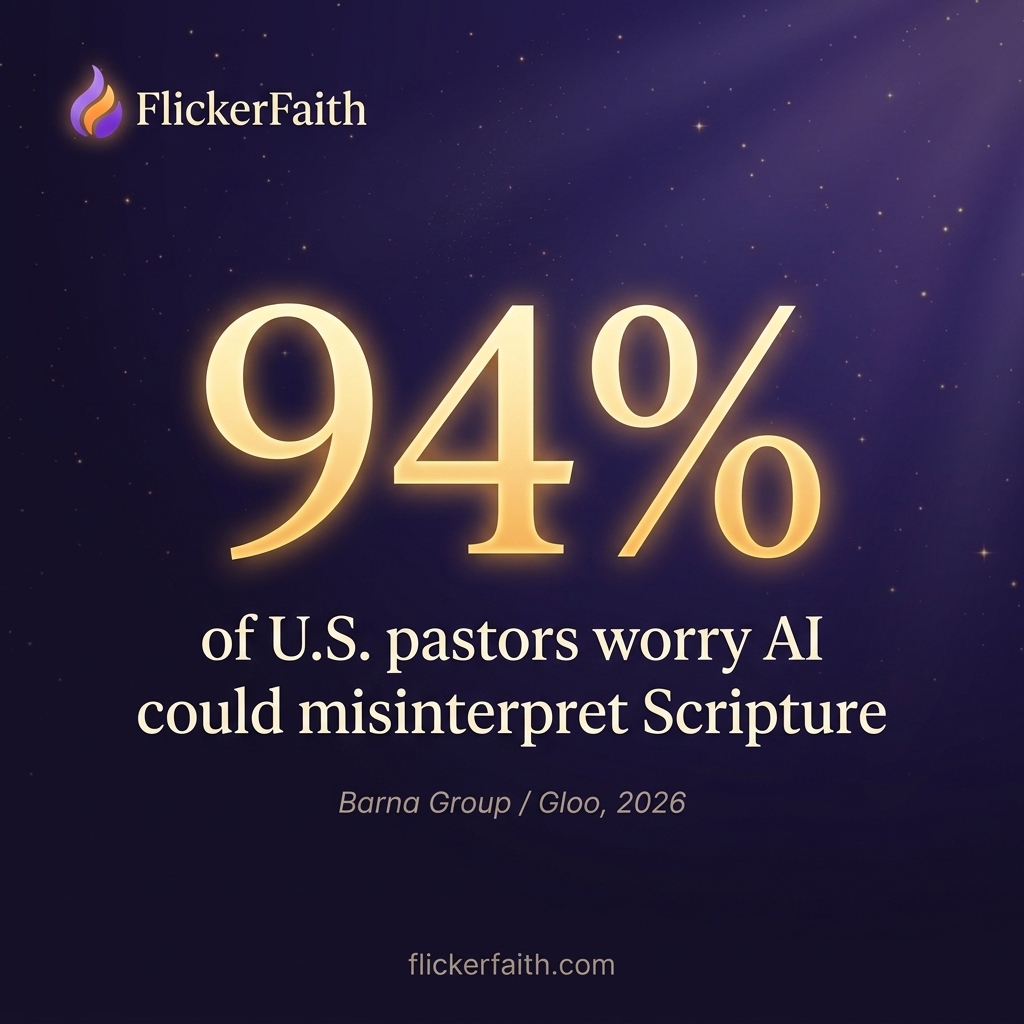
- 94%of pastors worry AI could misinterpret Scripture — along with 83% of practicing Christians (Barna/Gloo).
- 73%of practicing Christians fear AI reliance could lead people away from faith (Barna/Gloo).
- 72%of practicing Christians worry AI could replace clergy (Barna/Gloo).
- ~65%of pastors fear AI could displace their spiritual guidance (Barna/Gloo).
Notice the ranking. The near-universal 94% concern about misinterpreting Scripture sits well above the fear of clergy being replaced. Pastors are less worried about their pensions than about a confident, fluent machine quietly getting the Bible wrong — and a congregation trusting it anyway. That instinct is sound; we take the replacement question head-on in will AI replace pastors?
It's worth saying clearly what the research does not claim. On general Bible knowledge and trivia, top AI models score above 90%. The documented failure is narrower and more serious: verbatim quotation, correct citation, and sound theological reasoning. In other words, the problem isn't that mainstream AI has never heard of the Bible — it's that a general-purpose system can't be trusted to quote it exactly or interpret it faithfully by default.
Where a Scripture-first tool fits
This is exactly the gap FlickerFaith was built to close. The data describes a category problem — mainstream, general-purpose AI treating the Bible like any other text to be averaged and paraphrased. FlickerFaith takes the opposite approach: it's a purpose-built Christian AI that draws verses from a whole-Bible reader spanning 26 real, licensed and public-domain translations, cites what it references instead of paraphrasing from memory, and is biblically guarded so answers stay grounded in the text rather than the culture.
General-purpose AI
- ×Predicts likely wording — blends translations into phrasing that matches none of them
- ×Can invent chapter-and-verse references and state them with total confidence
- ×Interprets Scripture through the average of its training data, secular defaults included
- ×The category 72% of pastors call a "threat" and 79% call biased
FlickerFaith
- ✓Draws verses from 26 real, licensed and public-domain translations
- ✓Cites what it references — Scripture shown, not recalled from memory
- ✓Biblically guarded, answering through a biblical worldview by design
- ✓Backed by Strong's, an interlinear, 28 commentaries, and cross-references for your own study
For pastors, that difference is the whole point. AI used as a research and drafting partner — Copeland's "prepare for ministry, not replace it" — is only safe when its Scripture claims can be verified against a named translation. FlickerFaith builds that verification in rather than bolting it on. See it applied in the sermon prep workflow, or browse the full feature list.
Frequently asked questions
How many pastors use AI?
About 87% of Protestant pastors now use AI in ministry, and only 13% do not, according to Barna Group / Gloo, 2026 (fielded late 2025). A separate nationwide AiForChurchLeaders survey shared through Exponential found that 91% of church leaders support AI use to some degree, and church-leader adoption climbed from roughly 38% in 2023 to 66% in 2024.
What do pastors use AI for?
The most common pastoral uses are brainstorming (50%), graphic design (37%), biblical and theological research (36%), writing small-group questions (34%), and administrative work (34%), per Barna/Gloo. Twenty-four percent of pastors now use AI to write or edit sermons — double the 12% recorded in early 2024.
Do pastors trust AI?
Most pastors use AI but do not fully trust it, especially with Scripture. According to Barna/Gloo, 72% of pastors call AI a threat, 79% say AI is biased, and only 12% feel prepared to give their congregation guidance on using it.
What are pastors most afraid of with AI?
The single biggest fear is doctrinal: 94% of pastors and 83% of practicing Christians worry AI could misinterpret Scripture (Barna/Gloo). Beyond that, 72% worry AI could replace clergy, roughly 65% fear it could displace their spiritual guidance, and 73% fear reliance on AI could lead people away from faith.
Is AI accurate enough for pastors to use in sermon prep?
Not on its own for verbatim Scripture. YouVersion CEO Bobby Gruenewald says the best-performing AI models misquote Scripture at least 15% of the time, and some as much as 60% of the time. General-purpose AI is useful for brainstorming and research, but pastors should verify every quotation against a named translation or use a Scripture-first tool that cites its sources. More in should pastors use AI for sermons?
Sources: Pastor adoption, use-case percentages, and concern figures from Barna Group / Gloo, "Pastors Are Using AI More Than You Think", "Christians View AI as Gift and Threat", "AI is Becoming a Spiritual Authority", and "Practicing Christians are Adopting AI Rapidly" (Barna/Gloo, 2026, fielded late 2025). Church-leader support/frequency figures via the AiForChurchLeaders / Exponential nationwide survey; the 38%→66% growth via Gloo. The 15%–60% misquote figure is attributed to Bobby Gruenewald (YouVersion CEO), reported by The Christian Post.
"Prove all things; hold fast that which is good." — 1 Thessalonians 5:21
A Scripture-first Christian AI for study, prep, and prayer. Free to start — Premium is $3.99/mo or $34.99/yr.