
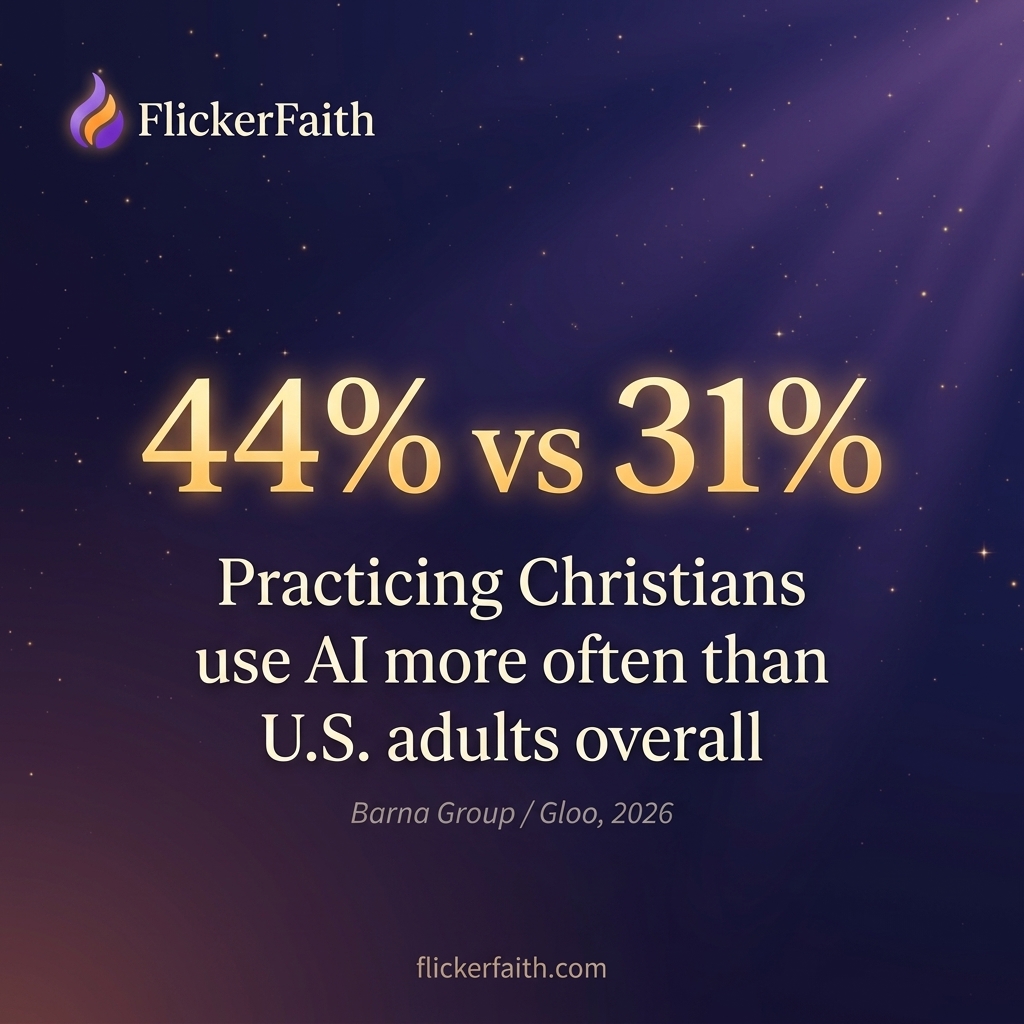
Christians are adopting AI faster than the general public. 44% of practicing Christians in the U.S. now use AI often or very often, versus 31% of U.S. adults overall, and 87% of Protestant pastors use AI in ministry (Barna Group / Gloo, 2026, fielded late 2025). Yet the very people using it most do not trust it with Scripture.
"Prove all things; hold fast that which is good." — 1 Thessalonians 5:21 (KJV)
How many people use AI at all? (The context)
Christian adoption isn't happening in a vacuum — it's riding a historic surge in AI use across the whole population. In just three years, the share of U.S. adults who have used a conversational AI tool has roughly tripled, and it's still climbing. Before we look at how Christians compare, here's the baseline the general public sets.
| Metric | Figure | Source |
|---|---|---|
| U.S. adults who have used the leading AI chatbot | 18% → 34% → 44% | Pew Research Center (2023 → 2025 → 2026) |
| U.S. adults who used an AI chatbot in 2026 | 49% | Pew Research Center (up from 33% in 2024) |
| Weekly generative-AI use across 6 countries | 18% → 34% | Reuters Institute (2024 → 2025) |
| U.S. employees using AI at work at least occasionally | 45% | Gallup (10% use it daily) |
| Organizations using AI in at least one business function | 88% | McKinsey (State of AI, 2025) |
Sources: Pew Research Center, "Americans and AI 2026"; Reuters Institute, "Generative AI and News Report 2025"; Gallup, "AI Use at Work Rises"; McKinsey, "The State of AI in 2025."
Do Christians use AI more than the public?
Yes — and by a clear margin. Barna Group's research found that practicing Christians are adopting AI more heavily than U.S. adults as a whole, both in daily life and at work. The gap holds even after you account for age and profession.
| Group | Personal use | Use at work |
|---|---|---|
| Practicing Christians | 44% | 39% |
| U.S. adults (general public) | 31% | 26% |
| Non-practicing Christians | 29% | — |
| Pastors (personal use) | 16% | — |
Source: Barna Group, "Practicing Christians Are Adopting AI Rapidly" (2026, fielded late 2025).
The headline is striking: 44% of practicing Christians use AI often or very often, versus 31% of the general public — and 39% use it often at work versus 26% of U.S. adults. Notably, everyday believers report far heavier personal use than their pastors (16%), which points to a leadership gap we'll return to below.
How many pastors use AI in ministry?
The pastoral numbers surprised even the researchers. Far from resisting the technology, the overwhelming majority of Protestant pastors have already folded AI into the work of ministry — for sermon prep, design, research, and administration.
| Metric | Figure | Detail |
|---|---|---|
| Protestant pastors who use AI in ministry | 87% | Only 13% do not |
| Pastors using AI to write or edit sermons | 24% | Roughly double the 12% in early 2024 |
| Brainstorming ideas | 50% | Top reported use |
| Graphic design | 37% | Slides, social, print |
| Biblical / theological research | 36% | Study and reference |
| Small-group questions & admin | 34% | Each |
Source: Barna Group / Gloo, "Pastors Are Using AI More Than You Think" (2026, fielded late 2025).
A separate nationwide survey of church leaders reports the same trajectory from a different angle: 91% of church leaders support AI use to some degree, 61% use it weekly or daily (up from 43% in 2024), and 64% of preaching pastors use it in sermon prep (AiForChurchLeaders.com & Exponential, via PR Newswire). Gloo's own tracking shows ministry-leader AI use surging from roughly 38% in 2023 to about 66% in 2024 (Gloo survey). For a fuller breakdown, see our sibling data page on pastors and AI statistics.
Do Christians trust AI as a spiritual authority?
This is where the data turns from interesting to sobering. Adoption has outrun discernment: a meaningful share of believers now treat AI not just as a productivity tool, but as a source of spiritual guidance — and younger Christians most of all.
| Metric | Figure |
|---|---|
| U.S. adults who say AI's spiritual advice is "just as trustworthy" as a pastor's | 30% |
| Practicing Christians who say the same | 34% |
| — among Gen Z | 39% |
| — among Millennials | 44% |
| Practicing Christians who would trust AI with their spiritual growth | 48% |
| Say AI already aids their prayer or Bible study | ~4 in 10 |
| Pastors who feel prepared to give guidance on using AI | 12% |
Source: Barna Group / Gloo, "AI Is Becoming a Spiritual Authority" (2026, fielded late 2025); pastor-preparedness figure from Barna, "Practicing Christians Are Adopting AI Rapidly."
Read those two facts side by side: nearly half of practicing Christians would trust AI with their spiritual growth, while only 12% of pastors feel equipped to guide them on it. That is the gap that keeps church leaders up at night — and it's explored further in our page on what Christians think about AI.
What are Christians worried about?
For all the enthusiasm, concern runs even higher — especially about Scripture. The same believers adopting AI overwhelmingly fear it will get the Bible wrong, carry bias, or pull people away from real faith and community.
| Concern | Figure | Group |
|---|---|---|
| Worry AI could misinterpret Scripture | 94% | Pastors |
| Worry AI could misinterpret Scripture | 83% | Practicing Christians |
| Say AI is biased | 79% | Pastors |
| Fear AI reliance could lead people away from faith | 73% | Practicing Christians |
| Call AI a "threat" | 72% | Pastors |
| Worry AI could replace clergy | 72% | Practicing Christians |
| Fear AI could substitute for God | 65% | Practicing Christians |
| Concerned about data privacy | 83% | Church leaders |
| Churches with any AI-use policy | 5% | Church leaders |
Sources: Barna Group / Gloo, "AI Is Becoming a Spiritual Authority"; Barna / Gloo, "Christians View AI as Gift and Threat"; Barna, "Church Leaders' AI Usage & Concerns" (all 2026, fielded late 2025).
How accurate is AI with the Bible?
The concern about Scripture isn't just a feeling — it's measurable. The most-cited figure comes from Bobby Gruenewald, founder and CEO of YouVersion, maker of the Bible App with more than a billion downloads. He has said the best general-purpose models fall short exactly where the words matter most.
"…the best model… misquotes Scripture at least 15% of the time. Some of them as much as 60% of the time." — Bobby Gruenewald
| Metric | Figure | Source |
|---|---|---|
| Rate at which the best general-purpose AI misquotes Scripture | 15–60% | Bobby Gruenewald, YouVersion CEO |
| Average score of leading AI models on a Christian benchmark | 61/100 | Gloo, Flourishing-AI (FAI-C) |
| Score on the "Faith" dimension (the lowest of all) | 48/100 | Gloo, Flourishing-AI (FAI-C) |
| General-purpose AI accuracy on Bible trivia | 90%+ | Andy Wong, AI Bible Trivia Benchmark |
Sources: Christian Daily International (also The Christian Post); Gloo, "Flourishing-AI (FAI-C) Benchmark" (Dec 2025); Andy Wong, "AI Bible Trivia Benchmark."
Read carefully, the numbers tell a precise story. General-purpose AI actually knows the Bible as a subject quite well — top models answer more than 90% of Bible trivia questions correctly. The documented failure is not general knowledge; it's verbatim quotation, correct citation, and sound doctrine. Gloo's benchmark of leading AI models makes the point bluntly: across every dimension it tested, "Faith" scored the lowest, at just 48 out of 100. For the full explanation of why this happens, see does AI get Bible verses wrong?
What the data means — and where FlickerFaith fits
Put the whole data set together and one pattern emerges: soaring use, colliding with collapsing trust. Christians are adopting AI faster than the public, a third already treat it as a spiritual authority, and yet the overwhelming majority worry it mishandles the very Scripture they'd turn to it for. That gap — between how much people use AI for faith and how little they can trust a general-purpose chatbot with the text — is precisely the problem Christian AI exists to solve.
FlickerFaith was built for exactly this moment. It is a Scripture-first, biblically guarded Christian AI — not a general chatbot with a Christian coat of paint. Rather than paraphrasing verses from memory (where the 15–60% misquote problem lives), it draws Scripture from a whole-Bible reader spanning real, licensed and public-domain translations, cites what it references, and keeps answers grounded in the text instead of cultural spin. It's a companion that points you back to God's Word, your church, and your own study — never a replacement for any of them.
Free to start. Premium is $3.99/mo or $34.99/yr.
Frequently asked questions
How many Christians use AI?
According to Barna Group and Gloo (2026, fielded late 2025), 44% of practicing Christians in the U.S. use AI often or very often, compared with 31% of U.S. adults overall. Among Protestant pastors, 87% report using AI in ministry. Christian adoption is running ahead of the general public.
Do Christians use AI more than the general public?
Yes. Barna Group found that 44% of practicing Christians use AI often or very often versus 31% of U.S. adults, and 39% use AI often at work versus 26% of U.S. adults. Practicing Christians are adopting AI faster than the wider population.
How many pastors use AI?
Barna Group and Gloo report that 87% of Protestant pastors now use AI in ministry, and only 13% do not. About 24% use AI to help write or edit sermons, roughly double the 12% who did so in early 2024. Top uses include brainstorming (50%), graphic design (37%), and biblical or theological research (36%).
Do Christians trust AI with Scripture and spiritual guidance?
Trust is rising but conflicted. Barna Group and Gloo found 34% of practicing Christians say AI's spiritual advice is as trustworthy as a pastor's, rising to 44% among Millennials, and 48% would trust AI with their spiritual growth. Yet 94% of pastors and 83% of practicing Christians worry AI could misinterpret Scripture.
How accurate is AI with the Bible?
Bobby Gruenewald, founder and CEO of YouVersion, says the best general-purpose AI models misquote Scripture at least 15% of the time, and some as much as 60%. Gloo's Christian benchmark scored leading AI models lowest on the "Faith" dimension at 48 out of 100. General-purpose AI answers Bible trivia well (90%+); the real failure is verbatim quotation, citation, and doctrine.
Sources & notes: General adoption figures from Pew Research Center, the Reuters Institute, Gallup, and McKinsey. Christian adoption, trust, and concern figures are from Barna Group and Barna / Gloo, cited as 2026 (fielded late 2025). The 15–60% Scripture-misquote figure is an expert assessment from Bobby Gruenewald, YouVersion CEO, and is attributed to him by name. Benchmark data from Gloo and Andy Wong.
"The heart of the prudent getteth knowledge; and the ear of the wise seeketh knowledge." — Proverbs 18:15 (KJV)
Explore the full topic on our pillar guide, AI and Christianity, or read what Christian AI is and whether AI gets Bible verses wrong.