
In 2026, AI and faith have collided at scale. Christians are adopting AI faster than the general public, a third now treat it as a spiritual authority, and mission agencies use it to accelerate Bible translation — even as pastors, the Vatican, and Bible technologists warn that mainstream AI mishandles Scripture. Here are the trends defining the moment.
"Ye can discern the face of the sky; but can ye not discern the signs of the times?" — Matthew 16:3 (KJV)
Adoption is surging — in the pews and the public
The headline story of 2026 is scale. According to the Pew Research Center, 49% of U.S. adults used an AI chatbot in 2026, up from 33% in 2024, with roughly one in eight using one several times a day. AI use has moved from novelty to daily habit in barely three years.
Christians are not sitting this out — they are leading it. Barna Group reports that 44% of practicing Christians use AI often or very often, versus 31% of U.S. adults, and 39% use it often at work versus 26% of the general public (Barna / Gloo, 2026, fielded late 2025). The clergy move even faster: 87% of Protestant pastors now use AI in ministry, with about 24% using it to help write or edit sermons — roughly double the 12% who did so in early 2024. The full breakdown lives on our Christian AI adoption statistics page, but the takeaway is simple: the faithful are early adopters, not late holdouts.
AI is quietly becoming a spiritual authority
Here the trend turns from productivity to formation. A growing share of believers now treat AI not as a tool but as a source of spiritual counsel. Barna Group and Gloo found that 34% of practicing Christians say AI's spiritual advice is "just as trustworthy" as a pastor's — a figure that climbs to 39% among Gen Z and 44% among Millennials (2026, fielded late 2025).
It goes deeper than a passing opinion. 48% of practicing Christians say they would trust AI with their own spiritual growth, and roughly four in ten report that AI already aids their prayer or Bible study. That is a profound shift in a single technology cycle: for millions, an app is becoming a spiritual companion. The opportunity is real, and so is the danger — a point we unpack in what Christians think about AI. The question is no longer whether people will bring their deepest questions to AI. They already are.
Trust and accuracy fears are rising in step with use
The same believers embracing AI are deeply uneasy about it — especially where Scripture is concerned. Barna Group and Gloo found that 94% of pastors and 83% of practicing Christians worry AI could misinterpret Scripture (2026, fielded late 2025). Adoption and anxiety are climbing together, which is the defining tension of the year.
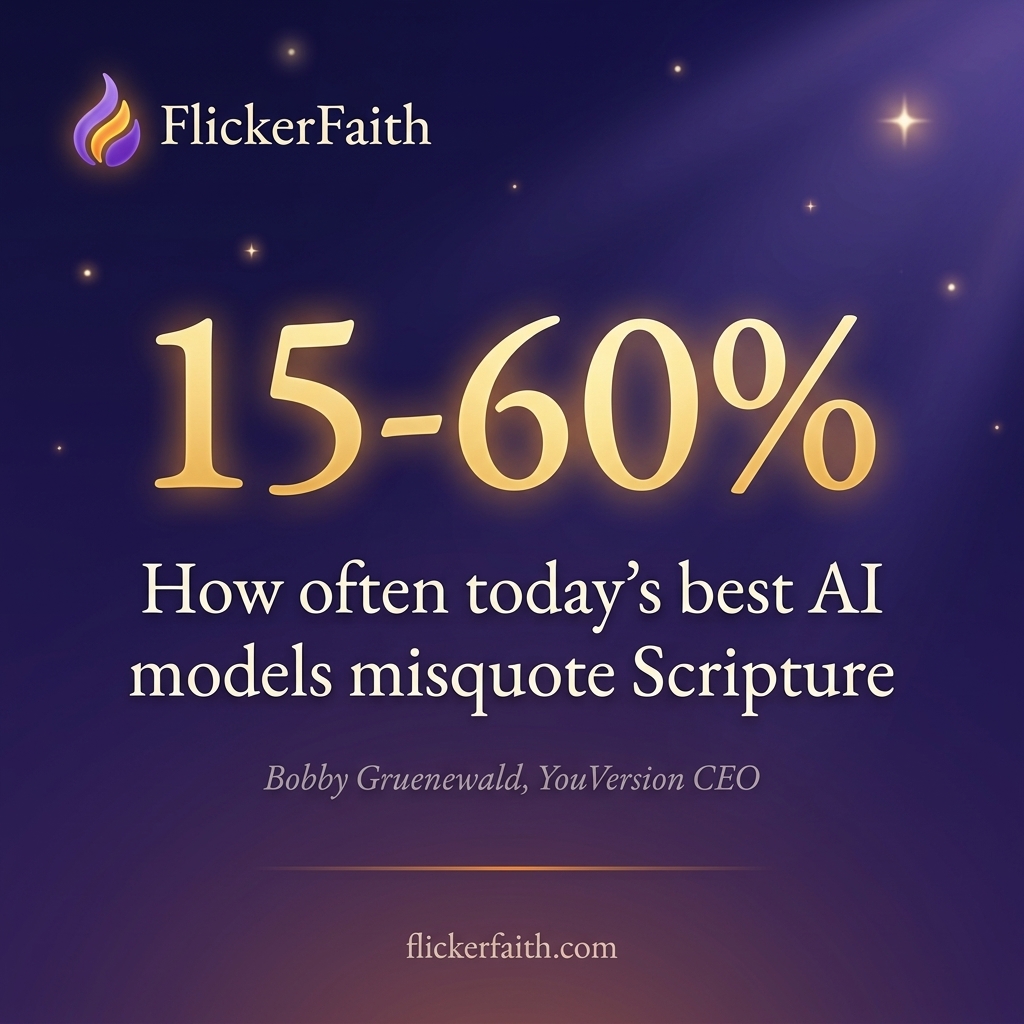
Those fears are measurable, not merely felt. Bobby Gruenewald, founder and CEO of YouVersion — the ministry behind the Bible App with more than a billion downloads — puts the problem in stark terms.
"…the best model… misquotes Scripture at least 15% of the time. Some of them as much as 60% of the time." — Bobby Gruenewald
Independent benchmarks tell the same story. Gloo's Flourishing-AI (FAI-C) Christian benchmark scored leading models an average of 61 out of 100, with "Faith" the lowest dimension of all, at just 48. As Gloo's Nick Skytland put it, "Today's leading AI models are not equipped to handle Christian concepts with depth or accuracy." Read carefully, though, the failure is precise. General-purpose AI answers Bible trivia well — top models clear 90% (Andy Wong's AI Bible Trivia Benchmark). What it fumbles is verbatim quotation, correct citation, and sound doctrine. For the mechanics of why, see does AI get Bible verses wrong?
The church is responding — from the Vatican to Nashville
Faith institutions are no longer reacting after the fact; in 2026 they are setting terms. The Vatican's 2025 document Antiqua et Nova draws a bright theological line: "The presumption of substituting God for an artifact of human making is idolatry." It warns against AI replacing human relationships, and against deepfakes and surveillance.
Protestant bodies have moved too. The Southern Baptist Convention's ERLC issued an "AI: An Evangelical Statement of Principles" (signed by 70-plus theologians) affirming that AI has no moral agency and must never be worshipped, and the SBC passed a 2023 resolution on AI and emerging technologies. Crucially, the response is not only cautionary — it is constructive. Gloo launched a $25M "AI and the Church" initiative plus a $1M hackathon to fund faith-aligned tools, and thinkers from John Lennox to The Gospel Coalition are shaping a stewardship framework rather than a ban. The mood is discernment, not denial.
AI is accelerating the mission
For all the concern, the most hopeful trend may be the quietest: AI is turbo-charging the spread of Scripture. Bible-translation timelines that once ran 20 to 25 years per language are collapsing to 4 to 5 with tools like Avodah AI, and one partner reported cutting time by 75-80% and cost by 60% (Religion Unplugged; Seed Company, "From Decades to Years"). Hundreds of language communities still await a first translation, and AI can now help draft an Old Testament in days once a New Testament exists.
The reach is staggering. YouVersion's Bible App has passed 1 billion installs across 2,300+ languages, with more than 100 million monthly users and a single-day record of 19 million on November 2, 2025. Audio ministries such as Talking Bibles use AI voices to serve roughly a billion non-readers in 2,000+ languages. As Wycliffe president John Chesnut framed the moment, "This is the first generation that can look and say, 'This could happen during our lifetime.'" Used well, AI is an accelerant for the Great Commission, not a threat to it.
Controversies and cautions — where it goes wrong
The year also delivered cautionary tales worth heeding. A peer-reviewed study of five "AI Jesus" chatbots found they often gave evasive or unbiblical answers, shaped in part by profit motives (Verhoef, North-West University, via Crosswalk). Catholic Answers launched an AI apologist styled as a priest, "Father Justin," then demoted it from the priestly persona within about 24 hours after backlash (Forbes). And when a general-purpose chatbot was prompted to write a Bible-styled passage, the invented text spread online as though it were real Scripture — a reminder that AI can manufacture convincing counterfeit verses on request (Answers in Genesis).
The pattern is consistent: persona-driven "spiritual companion" chatbots and open-ended Bible bots tend to sound authoritative while drifting from the text and the creed. In The Gospel Coalition and Keller Center's AI Christian Benchmark, one leading model answered "Did Jesus rise from the dead?" by claiming there is "limited empirical evidence to support or refute the resurrection." The lesson is not fear of the technology, but insistence on accountability — every tool must be answerable to the Scripture and the doctrine it claims to represent.
Where trustworthy tools fit
Put the six trends together and one pattern dominates 2026: soaring use colliding with fragile trust. People are bringing their faith to AI faster than ever, a third already lean on it as a spiritual authority, and the mission is genuinely advancing — yet mainstream, general-purpose AI keeps stumbling over the very Scripture believers turn to it for. That gap is exactly what purpose-built Christian AI exists to close.
FlickerFaith was built for this moment. It is a Scripture-first, biblically guarded Christian AI — not a general chatbot with a Christian coat of paint. Instead of paraphrasing verses from memory (where the 15–60% misquote problem lives), it draws Scripture from a whole-Bible reader spanning real, licensed and public-domain translations, cites what it references, and keeps answers grounded in the text rather than cultural spin. And it is built with humility about its own place: a companion that points you back to God's Word, your church, and your own study — never a replacement for any of them. To see the full picture, start with our pillar guide, AI and Christianity.
Free to start. Premium is $3.99/mo or $34.99/yr.
Frequently asked questions
What are the biggest AI and faith trends in 2026?
Six trends define the year: adoption is surging (49% of U.S. adults used an AI chatbot; Christians outpace the public 44% vs 31%; 87% of pastors use AI in ministry); AI is becoming a spiritual authority (34% of practicing Christians rate its spiritual advice as trustworthy as a pastor's); trust and accuracy fears are rising (94% of pastors worry AI misinterprets Scripture); the church is responding (the Vatican's Antiqua et Nova, the SBC/ERLC, and a $25M Gloo fund); AI is accelerating mission (Bible translation compressing from 20-25 years to 4-5); and controversies over AI Jesus and persona chatbots are prompting caution.
Are Christians using AI more than other people?
Yes. Barna Group and Gloo (2026, fielded late 2025) found 44% of practicing Christians use AI often or very often, versus 31% of U.S. adults, and 87% of Protestant pastors use AI in ministry. Christian adoption is running ahead of the general public.
Do people trust AI for spiritual guidance?
Increasingly, and it worries church leaders. Barna Group and Gloo (2026, fielded late 2025) found 34% of practicing Christians say AI's spiritual advice is as trustworthy as a pastor's, rising to 39% among Gen Z, and 48% would trust AI with their spiritual growth. At the same time, 94% of pastors and 83% of practicing Christians worry AI could misinterpret Scripture.
How is the church responding to AI?
With both guardrails and investment. The Vatican's 2025 document Antiqua et Nova warns that "the presumption of substituting God for an artifact of human making is idolatry." The Southern Baptist Convention's ERLC issued an Evangelical Statement of Principles and a 2023 resolution on AI, and Gloo launched a $25M "AI and the Church" fund plus a $1M hackathon to build faith-aligned tools.
How is AI being used for missions and Bible translation?
AI is the flagship positive use case. Tools like Avodah AI are compressing Bible translation from 20-25 years to 4-5 years per language, and hundreds of language communities still await a first translation. YouVersion's Bible App has passed 1 billion installs in 2,300+ languages, and audio ministries use AI voices to reach roughly a billion non-readers.
Can AI be trusted with the Bible?
General-purpose AI is strong on Bible trivia (top models score 90%+) but weak where it counts most. Bobby Gruenewald, founder and CEO of YouVersion, says the best models misquote Scripture at least 15% of the time and some as much as 60%, and Gloo's Christian benchmark scored leading models lowest on "Faith" at 48 out of 100. The documented failure is verbatim quotation, citation, and doctrine, which is why Scripture-first tools like FlickerFaith draw verses from a fixed, licensed Bible library rather than paraphrasing from memory.
Sources & notes: Adoption figures from Pew Research Center, "Americans and AI 2026"; Christian adoption, trust, and concern figures from Barna Group, Barna / Gloo, "Pastors Are Using AI More Than You Think," and Barna / Gloo, "AI Is Becoming a Spiritual Authority," all cited as 2026 (fielded late 2025). The 15–60% Scripture-misquote figure is an expert assessment from Bobby Gruenewald, YouVersion CEO, attributed to him by name. Benchmark data from Gloo's Flourishing-AI (FAI-C), Andy Wong's AI Bible Trivia Benchmark, and The Gospel Coalition / Keller Center. Church response from the Vatican's Antiqua et Nova, the ERLC, and Gloo's "AI and the Church" initiative. Mission figures from Religion Unplugged, Seed Company, and The Christian Post. Controversy accounts from Crosswalk, Forbes, and Answers in Genesis.
"Jesus Christ the same yesterday, and to day, and for ever." — Hebrews 13:8 (KJV)
Go deeper on the pillar guide, AI and Christianity, or read the sourced data in Christian AI adoption statistics and what Christians think about AI.